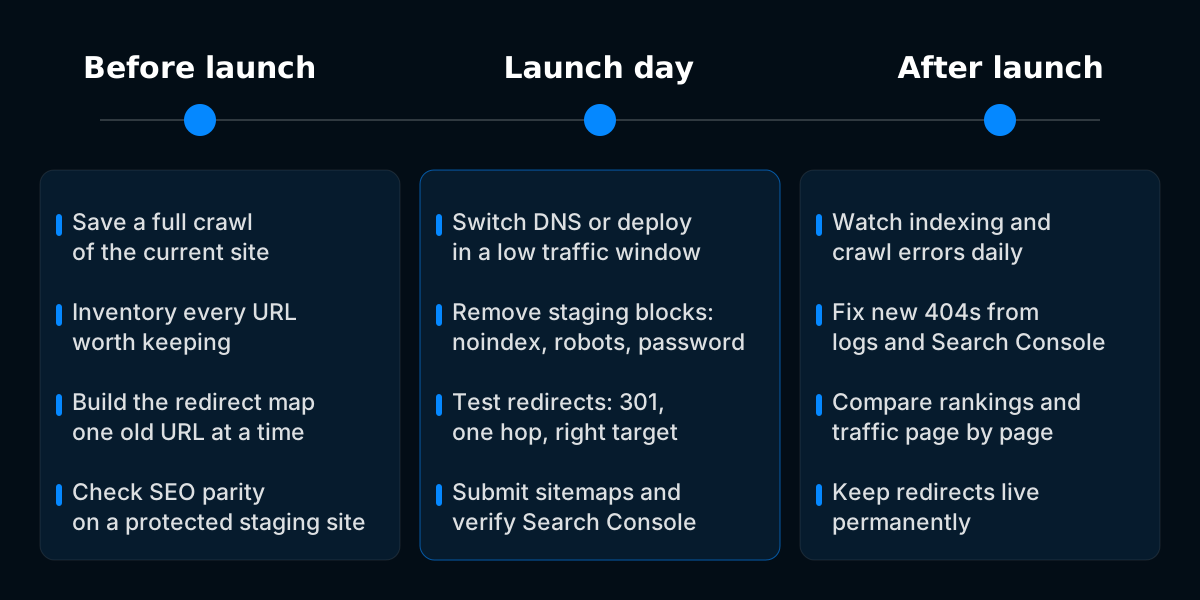
SEO migration
Website migration SEO checklist: before, during and after launch
Everything to check before, during and after a website migration so rankings, backlinks and traffic move with the site instead of staying behind.

A platform change is the one project where rankings, tracking, forms and checkout can all break in the same afternoon. We plan the move so the new site keeps earning from day one.
We run website migrations for businesses whose organic search already produces leads and sales, and who cannot afford to find out after launch that it stopped. You work with the people doing the work, with nobody in between. We cover WordPress, WooCommerce, Shopify, Webflow and custom stacks, including moves between any two of them.
When a migration goes wrong, the invoice for the project is the smallest number involved. Organic traffic that took years to build falls away over the following weeks. Leads stop arriving because a form posts to an endpoint that no longer exists. Orders drop because a payment step behaves differently on the new checkout. And if the tracking broke in the same release, nobody can even see how much is being lost, or where.
None of this comes from carelessness. It comes from treating a migration as a build project, when it is really a transfer of everything the old site does: its rankings, its content, its conversion paths, its integrations and its measurement. Every one of those has to be accounted for before launch, because recovering them afterwards takes months and some never come back.
Three commitments that shape every site migration we run, and the reason our launches are quieter than most.
We keep what already works. If the new platform can hold the existing URL structure, we keep it, and redirects are only written for URLs that genuinely have to change. The same principle applies to content, templates and conversion paths. A migration is not a redesign unless you have decided it should be, and every change we make is one you have agreed to.
We move the whole site, not just its pages. Content, metadata, schema markup, internal links, analytics, conversion events, forms, checkout, payment, email and CRM integrations, product feeds. The same structural work determines whether AI systems can read your pages well enough to cite them, so machine readable markup is checked alongside everything else.
We measure before and after. Rankings, organic traffic, conversions, indexation and Core Web Vitals are recorded before anything changes, then compared again after launch. That baseline is what turns a vague sense that things feel slower into a specific problem with a specific fix, found in days rather than discovered at the end of the quarter.
Six areas we plan, build and verify on every SEO migration. Each one is a place where sites routinely lose rankings or revenue, and each one is checked before launch rather than after.
Every page, template, integration, script and tracking tag the current site relies on, reconciled into one list so nothing is left behind by accident.
Existing structure kept wherever the platform allows it. Where a URL has to change, one permanent redirect to its true equivalent, with no chains.
Copy, headings, metadata, canonical signals, schema, images and internal links carried across intact rather than rebuilt from the new platform’s defaults.
Analytics, tag manager, conversion events and ad pixels rebuilt and verified, so the first week on the new site is measured as accurately as the last week on the old one.
Forms, checkout, payment, customer accounts, email and CRM integrations and product feeds tested end to end with real submissions before launch.
Performance, indexation, rankings and conversions tracked against the pre migration baseline, with fixes shipped as issues surface.
Current stack, target stack, and what the launch date depends on.
Rankings, traffic, conversions and speed recorded before anything moves.
What stays, what changes, and how each change is handled.
Every area tested end to end, including real form and checkout runs.
Controlled release, then measured against the baseline.
It starts with your environment rather than ours. We look at the current platform, the target platform, who else is working on the site and what the launch date actually depends on. We work with you directly, through Slack or whatever you already use, without a layer of account management between you and the people building the site.
Before anything changes we record a baseline of rankings, organic traffic, conversions and page speed, and we inventory everything the current site does. That record is the reference everything afterwards is measured against, and it cannot be recreated once the old site is gone.
The SEO migration plan comes next and it is written down. What stays exactly as it is, what has to change and why, and how each change is handled. Where something in the new build would cost rankings or break a conversion path, we raise it here, when the fix takes an afternoon rather than a recovery period.
Staging is where the plan gets proven. Content and markup are compared page against page, tracking fires are checked in the browser, forms are submitted and checkout is run with real test orders. Nothing goes live until that list is clear. Launch itself is controlled, and we verify the site within the first hour.
Monitoring continues afterwards as part of the engagement rather than as an upsell. If rankings, traffic or conversions move against the baseline, we find out why and fix it. Most clients continue on a retainer from there, because the site keeps changing and the same thinking applies to every change after the move.
Website migrations fail in the gap between the people who understand search and the people who write the code. As your SEO migration agency we are both, which removes the handoff where things get lost.
Security updates, plugin management and content changes handled with the same evaluation of ranking impact before anything is executed.
Learn moreSchema markup, canonical corrections, hreflang, sitemap optimization and redirect management, executed properly rather than filed as a recommendation.
Learn moreNew features and layout changes built with page speed and Core Web Vitals in mind, so a fast new site does not slowly become a slow one.
Learn moreA migration is scoped as a project and quoted from your URL inventory and the complexity of the move. Most clients continue on a monthly plan afterwards, because the site keeps changing after launch. Every plan covers development and optimization, and takes any request.
From $1,200 a month
See pricingThe things site owners ask before committing to a move. If yours is not here, ask us directly.
A migration is scoped as a project, quoted from the size of the URL inventory and the complexity of the move rather than from a price list. Most clients continue on a monthly retainer afterwards, from $1,200 a month, because the site keeps changing after launch.
The technical work usually runs two to six weeks depending on how many URLs and templates are involved, and monitoring continues after launch. The audit and the migration plan run in parallel with the build, so the work rarely moves a launch date that was already realistic.
Short term movement is normal while search engines recrawl a changed site. What we prevent is the sustained loss that comes from missing pages, lost markup or indexation problems. Anyone promising that nothing will move is describing something nobody controls.
No. If the new platform can hold your existing URL structure, we keep it and write nothing. Redirects are only for URLs that genuinely have to change, and each one goes to its true equivalent in a single permanent hop.
Yes, and that is most of what we do. The inventory and baseline exist precisely so we can work on sites we have never touched, including ones carrying years of technical debt from previous developers.
They are rebuilt and verified as part of the migration. Analytics, tag manager, conversion events and ad pixels are fired and checked on staging, so the first week on the new site is measured as accurately as the last week on the old one.
Monitoring is part of the engagement rather than an upsell. Everything is compared against the baseline recorded before the move, so a drop becomes a specific problem with a specific cause instead of a feeling that something is wrong.
Your developer can absolutely build the new site. The question is who owns the parts that decide whether search engines follow you through the move. If nobody on the project is checking URLs, markup and tracking against a baseline, that work is not happening, whoever writes the code.
SEO migration
Everything to check before, during and after a website migration so rankings, backlinks and traffic move with the site instead of staying behind.
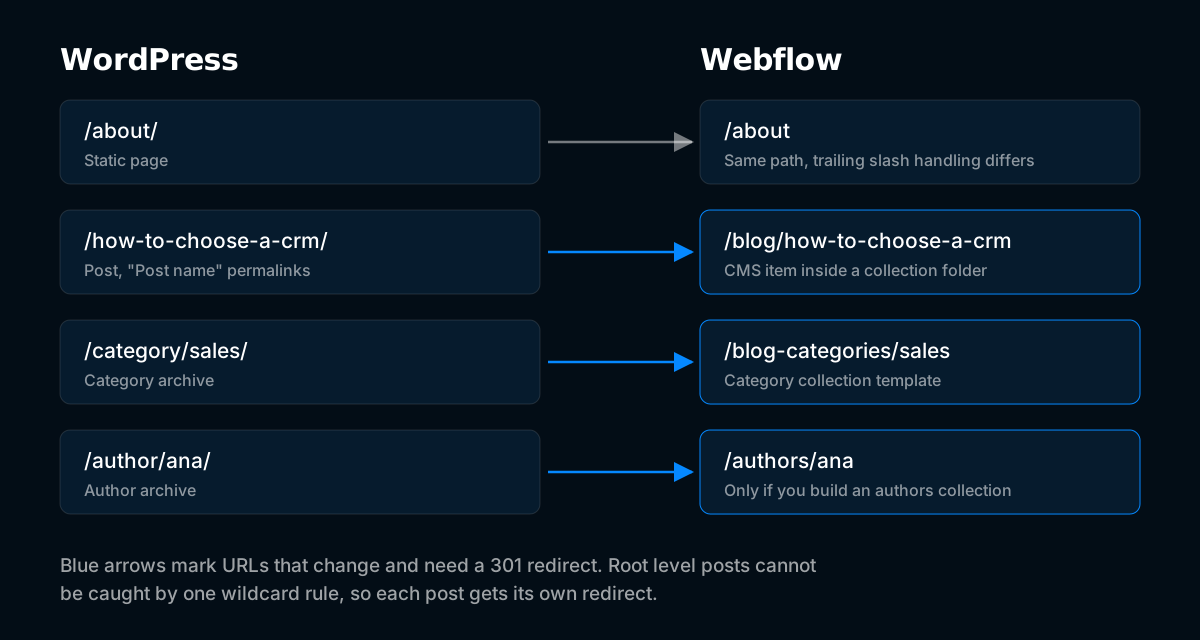
Platform migration
Moving from WordPress to Webflow is a rebuild, and post URLs often change. This guide covers the URL structure, redirects and SEO settings that keep rankings intact.
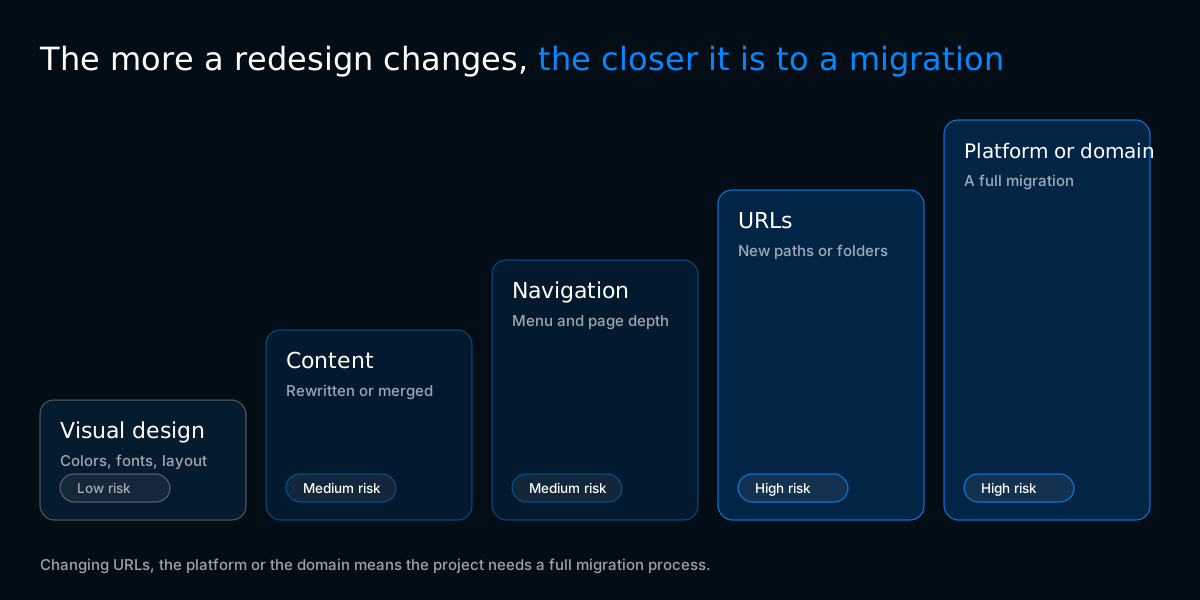
SEO migration
Redesigns lose traffic long before launch day, in decisions about content, navigation and URLs. This guide covers those decisions and includes a free SEO brief for your designer.
Tell us what is moving and when. We will tell you what is at risk and what it takes to protect it.