Develop
AI crawler access stays open, and issues found in monthly health checks are fixed.
$1,200/ month
Month to month, cancel anytime
Start with a free review
ChatGPT, Perplexity, Google AI Overviews and AI shopping agents can only cite what they can reach, read and understand. We find what stops them on your site and fix it in the code ourselves.
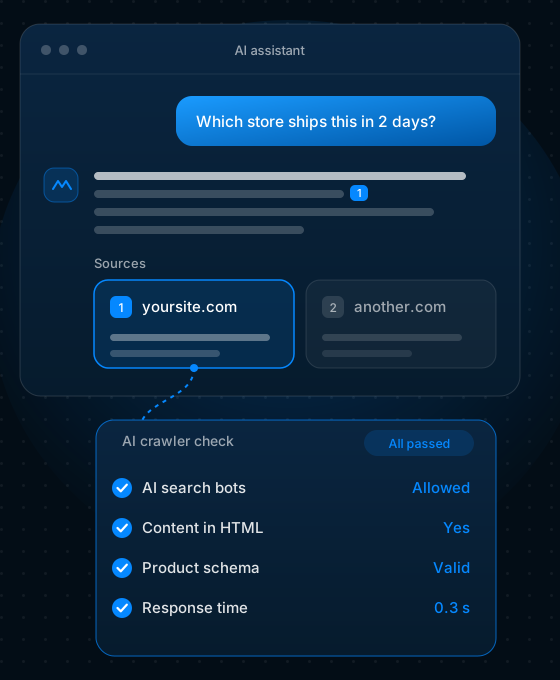
Your visitors see the finished page. Many AI crawlers only see the HTML your server sends. When content is built by JavaScript in the browser, that HTML can be almost empty.
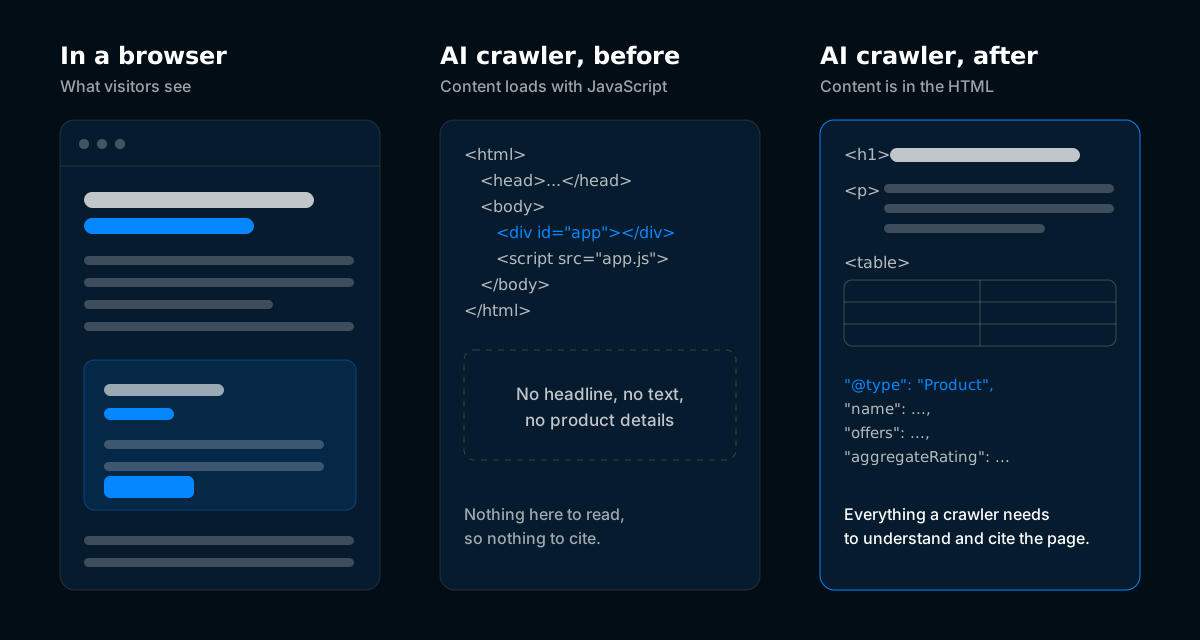
Generative engine optimization (GEO) and answer engine optimization (AEO) are the names for getting a site cited in AI answers instead of only ranked in a list of links. The goal is new. The technical foundation is not: an AI system has to reach the page, read its content and understand what it is about before it can use it.
That foundation is development work. Strategy, content and brand authority decide what AI systems say about you. Access, rendering and structure decide whether they can read you at all.
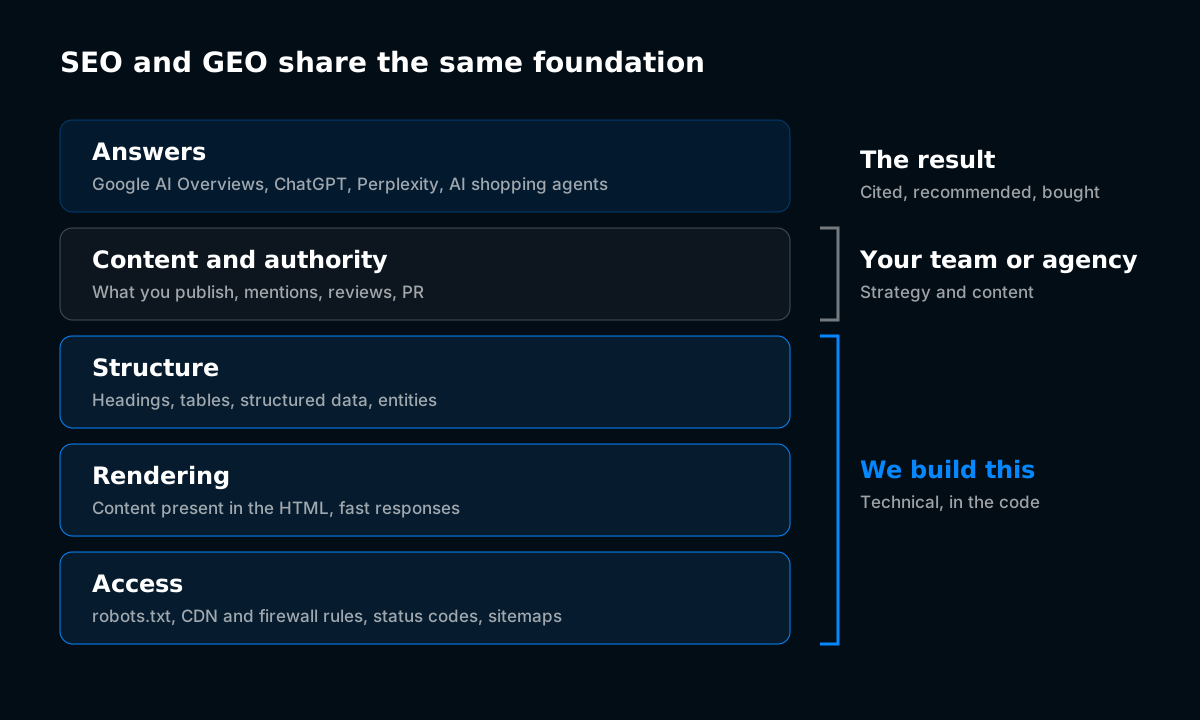
A site can rank on page one and still be invisible to AI search. The causes are almost always technical, and most site owners don't know they exist.
A robots.txt rule, a security plugin or a CDN setting turns AI search bots away, often without anyone choosing to.
Most AI crawlers read the HTML and do not run JavaScript. If your content loads in the browser, they receive an empty page.
Missing or broken structured data leaves AI systems guessing what is a product, a price, a review or an author.
Key facts sit in images, sliders, tabs or long paragraphs instead of clear headings, lists and tables that can be quoted.
Crawlers give up on pages that time out or return errors, and they come back less often.
Different prices, names or details on different pages make AI systems less likely to trust and repeat any of them.
We implement every change ourselves. You get working fixes on your site, not a report with recommendations for someone else to build.
We check robots.txt, firewall and CDN rules for every AI bot, and separate search bots from training bots so you decide which ones to allow.
We make sure the content that matters is in the HTML the server sends, not only in what the browser builds.
Organization, Product, Article, Breadcrumb, FAQ and author markup, connected so AI systems understand who you are and what you offer.
Templates with clear headings, lists and real tables, so your team's content is easy to quote. Your writers write, the structure does the rest.
Fast responses and stable status codes, so crawlers get the full page every time they ask.
Sitemaps, and llms.txt or agents.md where they help. We'll also tell you honestly what they don't do.
We show you which AI bots visit your site, which pages they read and what they skip, using your server or CDN logs.
Shopify connects stores to ChatGPT, Google AI Mode and Gemini, Copilot and Meta out of the box. WooCommerce's official routes are still emerging, so most WooCommerce stores have to be prepared by hand. That is what we do: complete product data, product structured data, a Merchant Center feed with the attributes Google added for AI shopping, verified access for AI bots and discovery files.
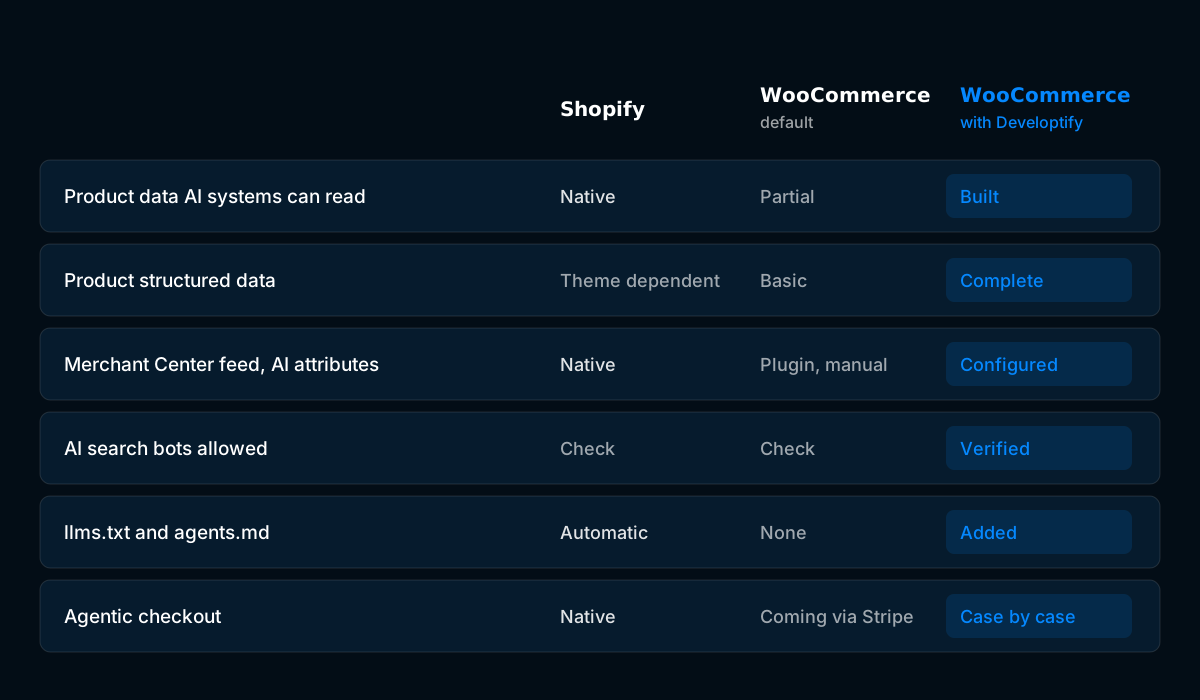
Agentic checkout, where an AI assistant completes the purchase, is still new on WooCommerce and depends on each channel's approval and product rules. We evaluate it case by case instead of promising it. Moving from Shopify? Read our Shopify to WooCommerce migration guide.
We don't write your content, run PR or track brand mentions in AI answers. What we guarantee is that nothing technical stands between your content and the AI systems reading it.
For agencies: if you sell GEO or AEO to your clients, we are the development team that implements your recommendations, on WordPress, WooCommerce, Shopify or Webflow, without breaking what already ranks.
From a free review to verified fixes, without changing how your team works.
We check AI crawler access, rendering and structured data on your key pages, and send you what we found.
You get the fixes in priority order, with a clear scope and price.
We make the changes on your site, tested on staging first.
We confirm the fixes in your logs and testing tools: bots reach the pages, content is in the HTML and structured data validates.
Every Developtify plan already looks after your site's AI search readiness, at the level of the plan. When you want AI search to be the only priority, a dedicated one-off project gives it our full focus until everything from the review is fixed.
AI crawler access stays open, and issues found in monthly health checks are fixed.
Month to month, cancel anytime
Start with a free reviewEverything in Develop, plus a quarterly AI search review with every finding implemented.
Month to month, cancel anytime
Start with a free reviewEverything in DevelopPlus, plus an ongoing AI search plan we propose and deliver.
Month to month, cancel anytime
Start with a free reviewOne plan covers your whole site: development, maintenance, technical SEO, performance and AI search. Compare plans
From $1,800
Starting price for small sites. Larger sites, WooCommerce stores and multilingual sites are quoted after the free review.
Scope: AI search only. The project ends after verification.
Agencies: contact us for partner pricing.
The goal is different: being cited in AI answers rather than ranked in search results. The technical foundation is the same. A site that search engines can crawl, render and understand is also one AI systems can use, which is why we treat GEO as part of technical SEO, not a replacement for it. Read more in our GEO vs SEO guide.
No one can. AI systems decide what to cite based on many factors, including content and authority that sit outside the code. We remove the technical barriers, so your site is eligible to be cited and nothing on our side holds it back.
It is cheap to add and does no harm, but server log studies show that major AI search crawlers rarely request it. We add it where it helps, and focus first on what AI crawlers actually read: your HTML, structured data and robots.txt.
That is your decision, and it does not have to be all or nothing. Some bots collect training data, others fetch pages to answer a user's question in real time. We can block training bots and still allow the ones that send visitors and citations.
Yes. Agencies are a large part of our work. Your agency sets the strategy, we implement the technical side and report back on what changed.
It depends on how often each AI system revisits your pages. Access and rendering fixes take effect as soon as bots return, which on most sites happens within days to weeks. We show you in the logs when they do.
Schema markup, canonical corrections, hreflang, sitemap optimization and redirect management, executed properly rather than filed as a recommendation.
Learn moreCore Web Vitals, render blocking, image and script weight, fixed in the code as a dedicated project or kept in check on a monthly plan.
Learn morePlatform moves, redesigns and domain changes planned URL by URL, so the rankings you already have come with you.
Learn moreSend us your URL. We'll start with a free AI search review and tell you what's stopping AI systems from reading and citing your pages.