SEO migration
Website redesign SEO: keep your rankings before the design starts
Redesigns lose traffic long before launch day, in decisions about content, navigation and URLs. This guide covers those decisions and includes a free SEO brief for your designer.
A website redesign keeps its rankings when the pages that earn traffic survive the redesign with their content, their URLs or a redirect, and their place in the site's navigation. Most of that is decided long before launch, in the brief, the content decisions and the wireframes.
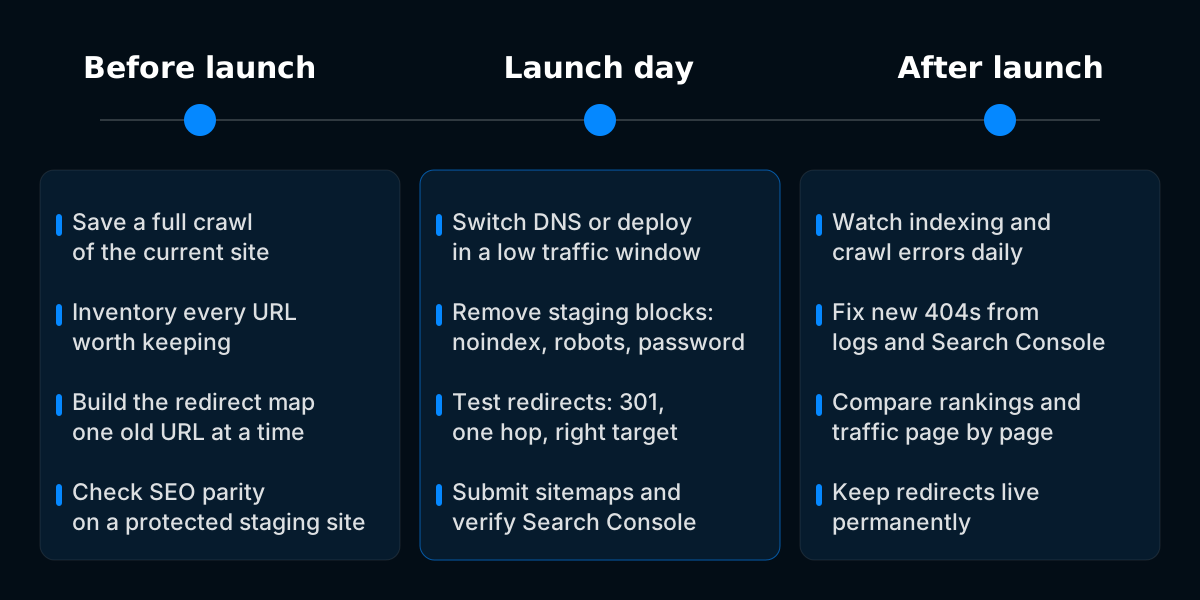
Launch day is where problems become visible, not where they start. This guide covers the decisions before and during the design, and links to our website migration SEO checklist for the launch itself.
Is your redesign actually a migration?
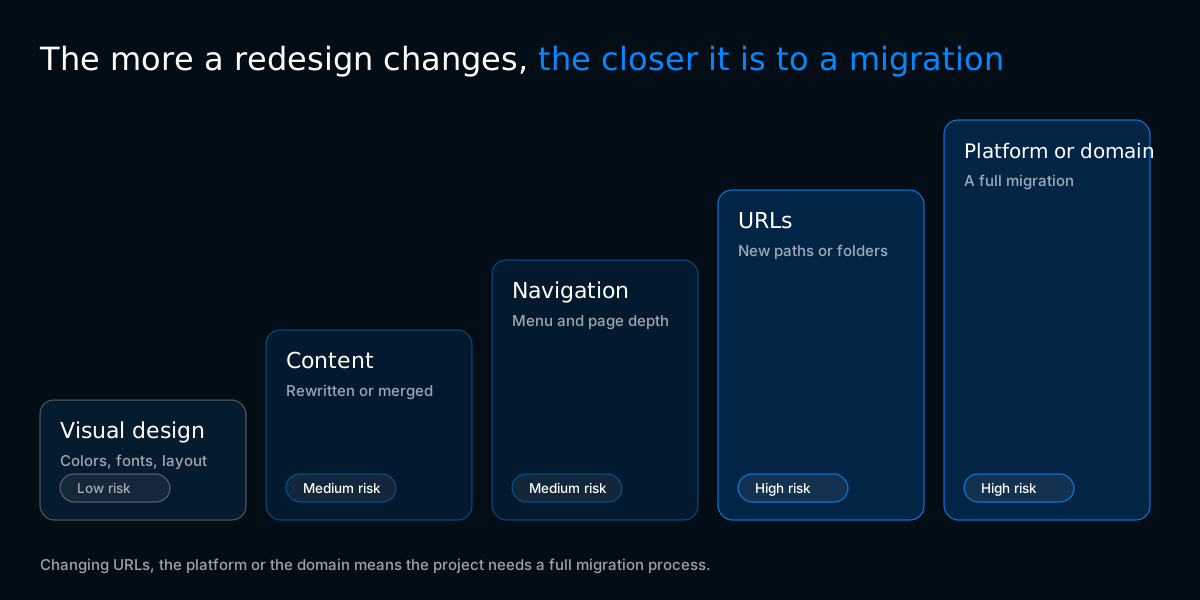
A redesign becomes a migration as soon as URLs, the platform or the domain change. Many teams only notice this after traffic drops, because the project was planned as "a new look".
| What changes | Example | SEO risk | What you need |
|---|---|---|---|
| Visual design only | New colors, fonts, layout | Low | Speed and template checks |
| Content | Pages rewritten, shortened or merged | Medium | Content decisions based on data |
| Navigation | New menu, pages moved deeper | Medium | Internal link review |
| URLs | New paths or a new folder structure | High | Full redirect map |
| Platform or domain | WordPress to Webflow, new domain | High | A full migration process |
If your project touches the last two rows, treat it as a migration from day one. Google's documentation on site moves with URL changes applies to it in full (Google Search Central).
Decide what stays before anyone designs
Content decisions made for design reasons are the most common cause of lost traffic in a redesign. A shorter page looks better in a mockup. It also loses the text that ranked.
Before the design starts, list every page and decide its future with data, not taste. Pull clicks and impressions from Search Console, sessions from analytics and linked pages from your backlink tool.
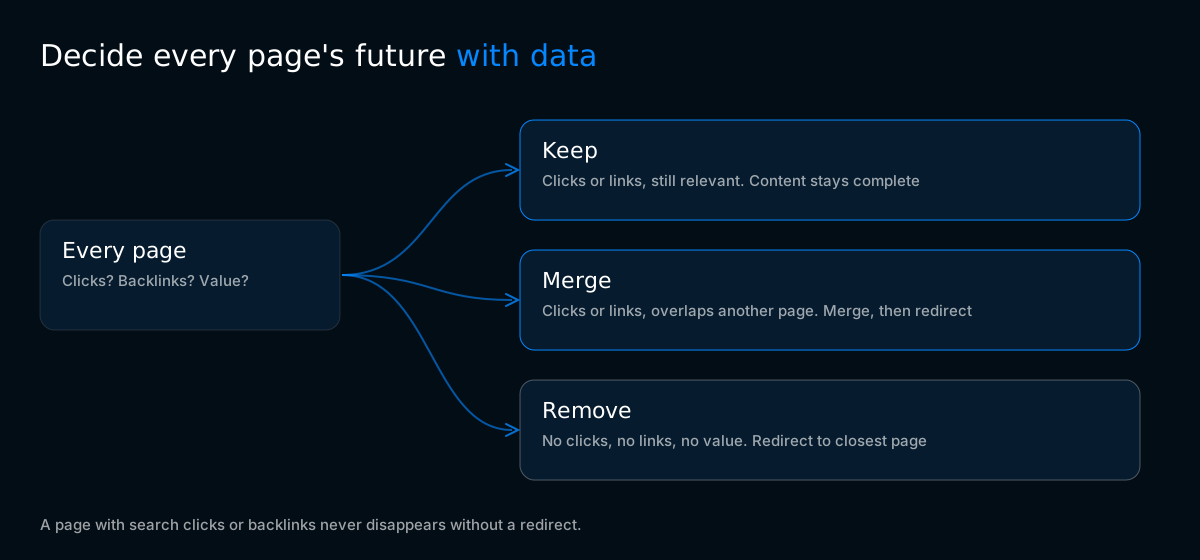
| Page has | Decision |
|---|---|
| Search clicks or backlinks, and is still relevant | Keep. Content stays at least as complete as now |
| Search clicks or backlinks, but overlaps with another page | Merge into the stronger page, then redirect |
| No clicks, no links, no business value | Remove, and redirect to the closest relevant page |
| No clicks, but needed by customers | Keep, even if it does not rank |
One rule matters more than the rest: a page with search clicks or backlinks never disappears without a redirect to its closest equivalent.
Give your designer an SEO brief
Designers and agencies make better decisions when SEO requirements are in the brief, not added in a review after the design is approved. A short SEO brief prevents most of the problems in this guide.
A useful brief answers six questions:
- Which pages must not lose content or rank? The list from the keep, merge or remove step, with your top pages by organic traffic.
- Which URLs stay the same? Ideally all of them. Any change needs a redirect, and should be agreed before wireframes.
- What does each template need? An H1, a title and meta description field, real text instead of text in images, and room for structured data.
- How deep can key pages sit? Pages that rank today should stay reachable from the main navigation or one click below it.
- What is the performance budget? Core Web Vitals passing on every template, which rules out some heavy hero videos, animations and font loads (Google Search Central).
- Who reviews SEO, and when? Name the person and the three review points in this guide.
Design choices that cost rankings
Some design choices look harmless in a mockup and quietly remove content or links from what search engines and AI crawlers can read.
- Text inside images. Headlines and key facts baked into banner images are not page text. Put text in HTML, with images beside it.
- Content that loads only on interaction. Google can index lazy-loaded content when it loads as it enters the viewport, but content that needs a click or a scroll event to load may not be seen (Google Search Central).
- Content built only with JavaScript. Google can render it, though it is an extra step (Google Search Central). Most AI crawlers don't render it at all, as our GEO vs SEO guide explains.
- Sliders for key content. Messages on later slides are easy to miss, and key content ends up split across slides instead of written on the page.
- Heavy hero media. Autoplay video, large images and many web fonts are the usual reasons a new design fails Core Web Vitals. Don't lazy-load the main hero image either, since it is likely the largest element on the page (Google Search Central).
- Links removed from the navigation. A simpler menu can push pages that rank today several clicks deeper, which weakens them.
Three points where SEO should review the work
A single SEO check before launch comes too late to change the design. Three short reviews at the right moments catch problems while they are still cheap to fix.
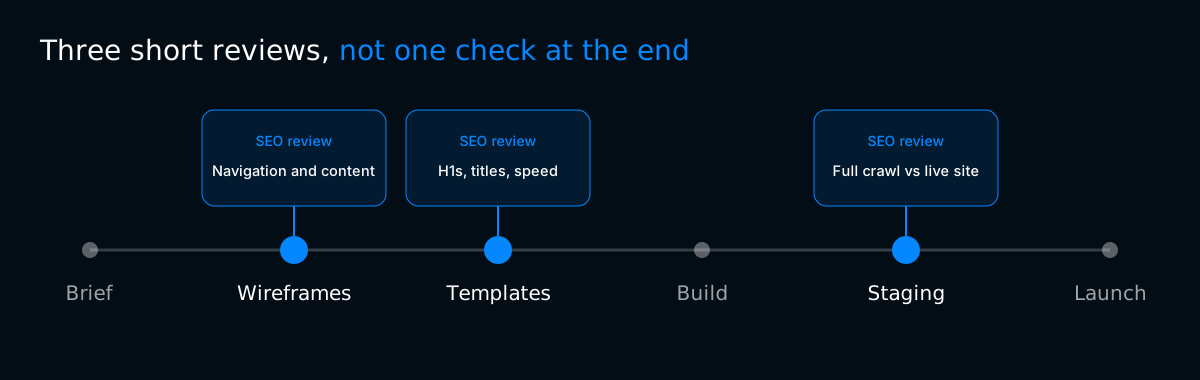
| Review point | What to check | Why then |
|---|---|---|
| Wireframes | Navigation, page structure, which content each page keeps | Changing a wireframe costs minutes |
| Templates | H1s, titles, text versus images, structured data, speed | Templates repeat across every page |
| Staging site | A full crawl compared with the live site, redirects, robots settings | Last chance before real traffic is affected |
The staging review overlaps with the pre-launch part of our website migration SEO checklist, which also covers launch day and the weeks after it.
After launch: normal movement or a real problem?
Some ranking movement after a redesign is normal while search engines recrawl the site. Google says to expect temporary fluctuation during a site move with URL changes (Google Search Central).
A real problem usually looks different:
- Specific pages drop while the rest hold steady. Check their redirect, content and internal links.
- 404 errors appear in Search Console for old URLs. Something is missing from the redirect map.
- Pages fall out of the index. Look for a noindex tag or blocking robots.txt rule left over from staging.
- The drop keeps growing after the first weeks instead of settling.
Compare page by page with the period before launch, not only total traffic. A stable total can hide a few important pages that lost everything.
When to get help
A redesign is worth planning with a specialist when the site earns meaningful revenue from search, has many pages that rank, or changes URLs, platform or domain along the way.
Developtify's website redesign service covers design and build with SEO protection from the first brief to the weeks after launch.
Frequently asked questions
How do you redesign a website without losing SEO?
Decide what happens to every page before the design starts, keep URLs the same wherever possible, redirect every URL that changes, keep the content of pages that rank, and check the new site against the old one before launch. Most traffic is lost through decisions in planning, not on launch day.
Does a website redesign affect SEO?
Yes, it can, in both directions. A redesign that removes content, changes URLs without redirects or slows the site down can lose rankings. One that keeps content and URLs and improves speed and structure can strengthen them.
Should I keep the same URLs when redesigning?
Yes, wherever you can. Unchanged URLs need no redirects and keep their signals immediately. Change them only when there is a clear reason, and redirect every old URL to its new address.
How long does it take for rankings to settle after a redesign?
It depends on the size of the site and how much changed. A design-only change usually settles quickly. A redesign that changes URLs behaves like a site move, which Google says can take weeks to process for a medium-sized site.
How much does it cost to redesign a website?
It depends on the number of pages and templates, whether design is included and the platform. As a reference, our redesigns start at $3,000 for a small site without a CMS and $5,000 with design. See website redesign services for details.