AI search
GEO vs SEO: what actually changes, and what doesn't
GEO and AEO are new names for getting cited in AI answers. This guide explains what they mean, what Google says about them, and which technical changes actually matter.
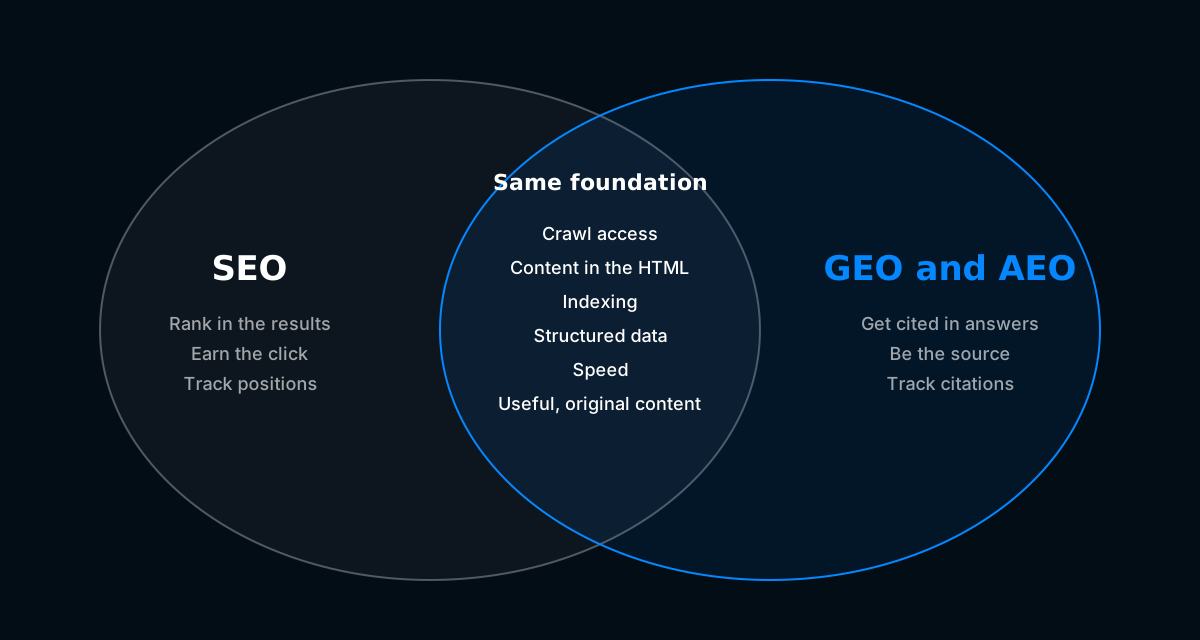
GEO and AEO are names for getting your site cited in AI answers, while SEO is about ranking in search results. The goal is new, but the foundation is familiar: to reliably use and cite your content, AI systems need to be able to discover, retrieve and understand it. That starts with many of the same technical foundations SEO already depends on.
Google's own position is that there is no separate discipline. In its guide for AI features, Google says that optimizing for generative AI search is optimizing for the search experience, and thus still SEO (Google Search Central). Other AI assistants work differently, though, and a few things really do change. This guide separates the two.
What GEO, AEO and SEO mean
GEO, AEO and SEO describe the same work aimed at different places where people find answers. The terms overlap, and most people use GEO and AEO interchangeably.
| Term | Stands for | Goal | Where it shows up |
|---|---|---|---|
| SEO | Search engine optimization | Rank in search results and earn the click | Google, Bing and other search engines |
| GEO | Generative engine optimization | Be cited or recommended in AI generated answers | ChatGPT, Perplexity, Gemini, Copilot, Google AI Overviews and AI Mode |
| AEO | Answer engine optimization | Be the answer, wherever an answer is shown | Featured snippets, voice assistants and AI answers |
The term GEO comes from a 2023 research paper that tested how content changes affect visibility in generative answers (Aggarwal et al., arXiv). Bing also uses the term, describing its AI citation reporting as an early step toward GEO tooling (Bing Webmaster Tools).
What Google says about GEO and AEO
Google treats GEO and AEO as part of SEO. Its generative AI features run on the same systems as regular search, so the same pages that can rank are the ones that can be shown.
The key points from Google's guide, published in May 2026:
- Same systems. Google says its generative AI features are rooted in its core Search ranking and quality systems (Search Engine Journal).
- Same entry requirement. A page must be indexed and eligible to be shown in Search with a snippet before it can appear in AI Overviews or AI Mode. The site must also be included in Search generative AI features in Search Console (Google Search Central).
- No special files. Google says you don't need new machine readable files, AI text files, special markup or Markdown, because Google Search doesn't use them (Google Search Central).
- Measurable in Search Console. A generative AI performance report shows how your content performs in AI features.
For Google, then, GEO is SEO. The differences show up with the other AI assistants.
GEO vs SEO: what is different
The biggest differences are in how you win, who reads your site and how you measure it. The table summarizes them.
| SEO | GEO | |
|---|---|---|
| Goal | A high position in the results | A citation or recommendation inside the answer |
| What gets used | The whole page | A passage, a fact, a table row |
| Queries | The phrase the user typed | Several related searches run by the AI |
| Who reads your site | Mostly Googlebot and Bingbot | Search engines plus each AI company's own crawlers |
| JavaScript | Google renders it | Most AI crawlers do not |
| Measurement | Positions, clicks, impressions | Citations, mentions, AI performance reports |
AI systems run several searches for one question
AI Mode and similar systems can split one question into several related searches across subtopics, a technique Google calls query fan-out (Google Search Central). A page can be cited for a sub-search the user never typed.
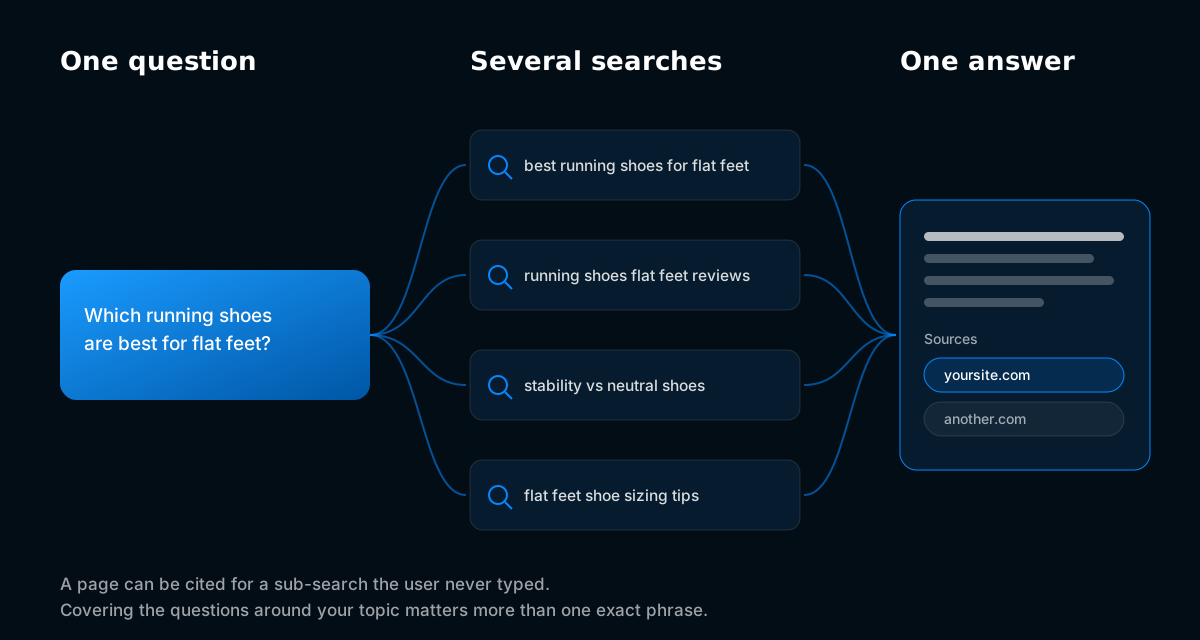
In practice, this rewards pages that cover a topic properly, including the follow-up questions around it, over pages built around one exact phrase. It does not mean one page per sub-search: Google warns that creating separate pages for fan-out variations to influence its AI answers violates its scaled content abuse policy (Google Search Central).
More crawlers read your site, and most AI crawlers don't execute JavaScript
Google renders JavaScript before it indexes a page. Most AI crawlers don't. A study by Vercel and MERJ found that none of the major AI crawlers rendered JavaScript, including OpenAI's crawlers and Anthropic's ClaudeBot (Vercel).
This is the most important technical difference between GEO and SEO. A site can rank well on Google while its client-rendered content stays invisible to crawlers that don't run JavaScript, such as those behind ChatGPT and Claude. Rendering important content on the server removes that dependency.
Different bots need different rules
AI companies run separate bots for separate jobs, and robots.txt can treat them differently. Blocking a bot that collects training data is a business decision. Blocking search or user bots stops them from reading your pages, which makes it much less likely you'll be cited.

Check robots.txt and also your CDN or firewall. Security settings and bot protection can turn AI crawlers away without anyone deciding to.
You measure citations, not only positions
In SEO, success is a position and a click. In GEO, success is being cited, and an AI answer may satisfy the user without a click at all. Google's Search Console has a generative AI performance report, while Bing Webmaster Tools has an AI Performance report showing citations, cited pages and grounding queries (Google Search Central, Bing Webmaster Tools). For other assistants, server logs show which AI bots read which pages. That shows crawler activity, not necessarily whether a page was ultimately cited in an answer, so the two should not be treated as the same metric.
What you don't need to do
A lot of GEO advice sells work that doesn't help. Google's guide lists several things that are unnecessary for its AI features (Google Search Central):
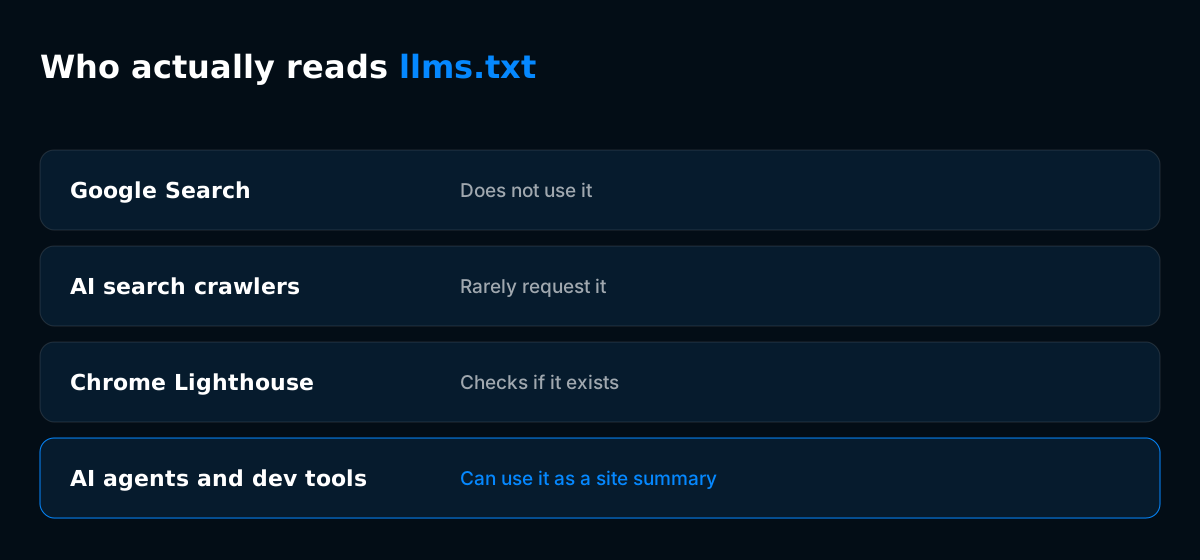
- llms.txt files. Google says it does not use llms.txt for Search. Available server-log studies also suggest that major AI crawlers rarely request the file today (Google Search Central, Ezy.ai research).
- Chunking content into small pieces for AI systems.
- Rewriting content in a special style for AI.
- Special AI schema. There is no schema.org markup specifically for AI features. Regular structured data remains useful for clearly describing entities, products, articles and other page content to systems that consume it.
If an agency's GEO proposal is built mostly on these, it is selling the label, not the result.
How to make your site ready for AI search
Most of the work is technical SEO done properly, with extra attention to the points where AI crawlers differ from Google.
| Check | How to test it | Why it matters |
|---|---|---|
| AI bots are allowed | Read robots.txt and your CDN or firewall bot rules | Blocked bots can't cite you |
| Content is in the HTML | View the page source, or fetch it with JavaScript disabled | Most AI crawlers don't run JavaScript |
| Pages are indexable | Search Console page indexing report | Google's AI features use only indexed pages |
| Structured data is valid | Rich Results Test on key templates | Helps systems understand products, articles and authors |
| Pages respond fast | Server response time and Core Web Vitals | Slow or failing responses make crawling less reliable, so systems may not get the full page every time |
| Facts are consistent | Compare prices, names and details across pages | Conflicting facts are less likely to be repeated |
| Content answers real questions | Check headings against the questions customers ask | Broader topic coverage can make a page relevant to more of the related searches generated during query fan-out |
| Changes are discoverable quickly | Check XML sitemaps, crawl logs and IndexNow where relevant | Search and AI systems need access to the current version of frequently changing content |
The first five are development work. If you already have them covered for SEO, much of the technical foundation for GEO is already in place.
When to get help
Being cited depends on content quality, relevance and authority. Being reliably found and read starts with the technical layer, which is where many sites quietly fail.
Developtify's AI search optimization service covers that technical layer: AI crawler access, rendering, structured data and monitoring, implemented in your code rather than handed over as a report. For the wider technical foundation, see our technical SEO services.
Frequently asked questions
Is SEO dead now that AI answers questions?
No. Google's AI features run on its core search systems and only use pages that are indexed and eligible for a snippet. Other AI assistants also rely on pages they can crawl and read. SEO is the foundation AI search is built on.
Can GEO replace SEO?
No. GEO doesn't replace SEO. The technical and content foundations overlap heavily, and Google's own AI features explicitly rely on its Search index and core ranking systems. GEO adds attention to citations, AI crawlers and retrieval behavior on top of that foundation.
Is GEO better than SEO?
They aren't alternatives. SEO focuses on visibility in search results, while GEO focuses on visibility and citations in generative answers. The technical and content foundations overlap heavily, so in practice the work differs less than the terminology suggests.
What is the difference between AEO and GEO?
AEO is the older and broader term, covering any place an answer is shown, including featured snippets and voice assistants. GEO focuses on answers written by generative AI. In practice, most people use them interchangeably.
Do I need a separate GEO agency?
Not necessarily. If your SEO team or agency handles content and strategy, the missing piece is usually technical: AI crawler access, rendering and structured data. A development team can implement that alongside your existing SEO work.