AI search
Agentic commerce: what it is and how to get your store ready
AI agents now find, compare and sometimes buy products for shoppers. This guide explains how it works, which protocols matter and what any store can do today.
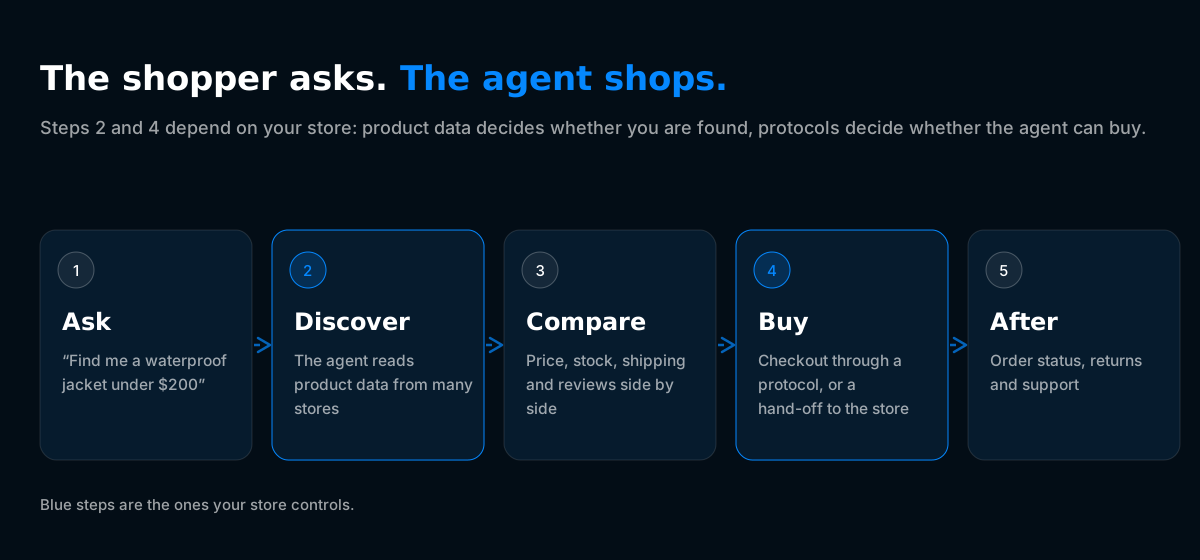
Agentic commerce is shopping where an AI agent does the work for the buyer: it finds products, compares them and, where the store supports it, completes the purchase. For a store, that means two things: product data an agent can read, and, for checkout, support for the protocols agents use to buy.
The first part is available to every store today. The second is new, changes fast and depends on your platform. This guide covers both, without the hype.
How agentic commerce works
A shopper describes what they want to an AI assistant, and the assistant handles the steps a shopper would normally do across several tabs. Instead of a list of links, the shopper gets a recommendation, and sometimes a finished order.
The steps that involve your store are discovery and checkout. In discovery, the agent reads product data from many stores: price, stock, shipping, reviews and descriptions. In checkout, the agent either completes the purchase through a commerce protocol or hands the shopper over to your store to finish.
Agentic AI is the general idea of AI that acts on its own toward a goal. Agentic commerce is that idea applied to buying and selling.
The protocols behind agentic checkout
Two open protocols define how AI agents buy from stores. Both are young and both have changed since launch.
| ACP | UCP | |
|---|---|---|
| Full name | Agentic Commerce Protocol | Universal Commerce Protocol |
| Built by | OpenAI and Stripe | Google, with Shopify, Etsy, Wayfair, Target and Walmart |
| Launched | September 29, 2025 | January 11, 2026 |
| Scope | The checkout between agent and store | The whole journey: discovery, checkout and after purchase |
| Where it's used | ChatGPT, and other assistants through Stripe | Google AI Mode and Gemini |
OpenAI and Stripe published ACP alongside Instant Checkout in ChatGPT in September 2025. Instant Checkout remains available for some eligible products and merchants (OpenAI), and the ACP specification remains active (Agentic Commerce Protocol). Google published UCP in January 2026 with Shopify, Etsy, Wayfair, Target and Walmart (Google Developers Blog).
On Google's side, UCP-powered checkout is currently available to selected merchants for eligible products in the United States, Canada and Australia. Merchant Center onboarding is rolling out gradually in the US, with Canada and Australia to follow (Google Merchant Center, Google Merchant Center onboarding). The UCP specification is still evolving, which is a good reason not to build anything custom against it without a clear need.
What your platform gives you
How ready your store is depends heavily on the platform it runs on. Shopify connects stores to AI channels natively. Most other platforms leave more of the work to you.
| Shopify | WooCommerce | Other platforms | |
|---|---|---|---|
| Connection to AI channels | Native, through Agentic Storefronts | Official routes emerging through Stripe and Google | Varies, check your platform |
| Verified answers for AI agents | Knowledge Base app | Not native | Varies |
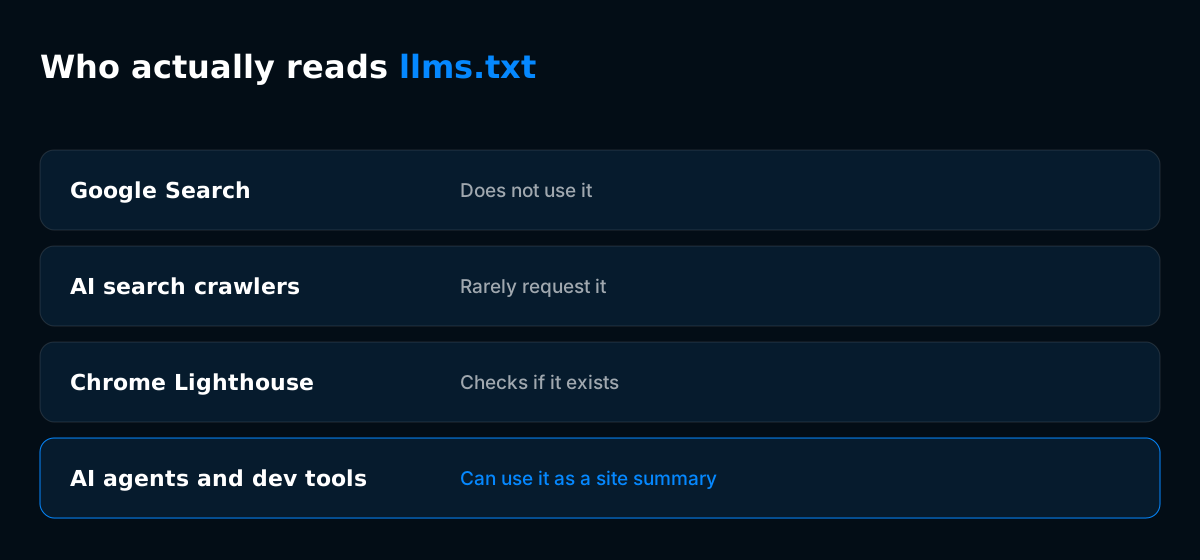
llms.txt and agents.md | Served automatically | Added manually or with a plugin | Usually added manually |
| Product feed for Google | Native integration | Plugin | Usually plugin or app |
Shopify's Agentic Storefronts connect eligible stores to AI shopping channels including ChatGPT, Google AI Mode and Gemini, Microsoft Copilot and Meta, and are active by default for eligible stores (Shopify Help Center). In ChatGPT, Shopify stores are a discovery channel and the purchase finishes on the store's own checkout. In Google AI Mode and Gemini, Copilot and Meta, shoppers can buy without leaving the channel when direct checkout is active. Shopify also serves agent-discovery files on every store: agents.md as the main file, plus llms.txt and llms-full.txt for older AI crawlers (Shopify Help Center).
WooCommerce doesn't connect stores to AI channels automatically the way Shopify does, but it now has official routes emerging: Stripe is bringing Agentic Commerce Suite support to Stripe for WooCommerce, while Google's AI shopping surfaces can already use Merchant Center product data (WooCommerce).
If you are deciding between platforms, or moving between them, this belongs in the decision. Our Shopify to WooCommerce migration guide covers what a store gives up in AI shopping when it leaves Shopify, and how to replace it.
How to get your store ready
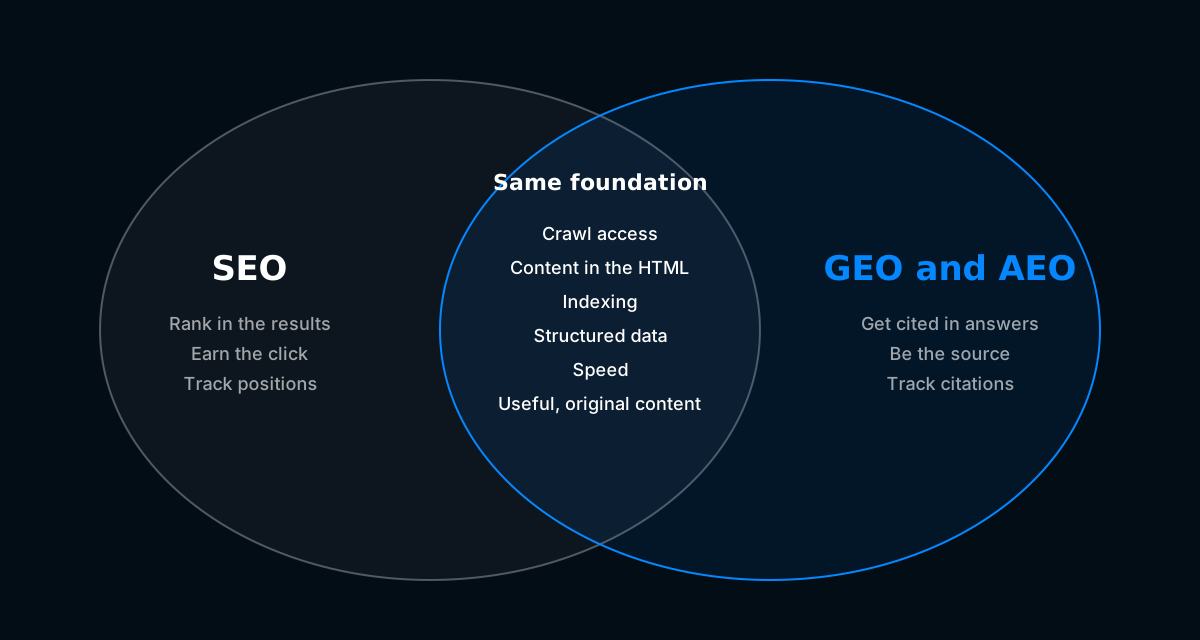
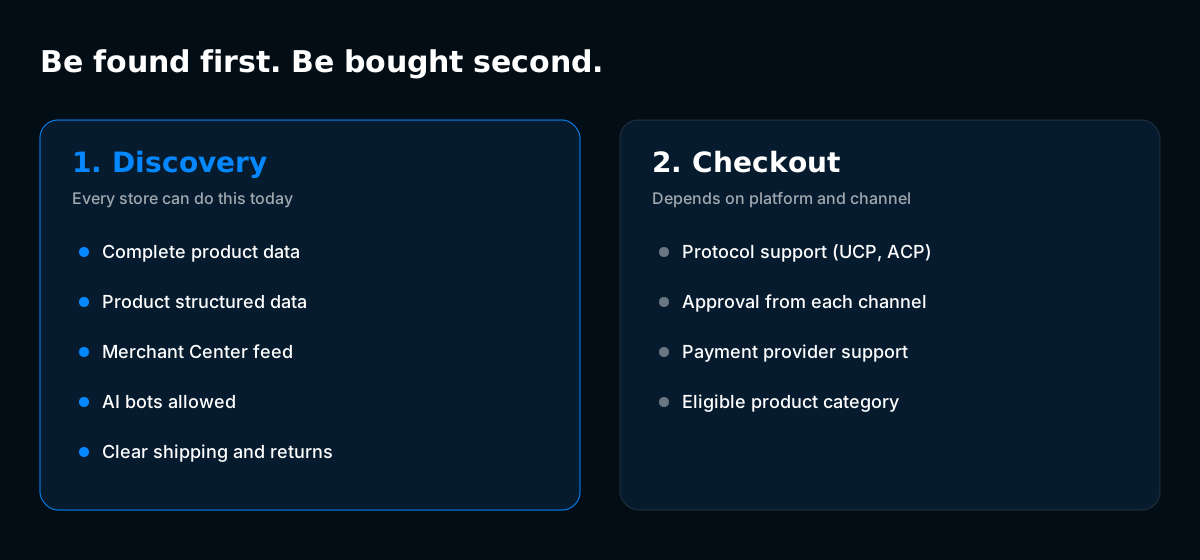
Get the discovery layer right first. It works for every AI channel, on every platform, and it also improves your regular search and shopping visibility. Checkout comes second, when your platform and channels support it.
Discovery: what every store can do now
- Complete product data. Titles, descriptions, variants, GTINs, brand, price and stock, filled in for every product. An agent can only compare what it can read.
- Product structured data. Product markup with price, availability, ratings and shipping, valid in the Rich Results Test.
- A Google Merchant Center feed. Google's AI shopping features use Merchant Center product data, and Google has added conversational product attributes and AI performance insights for merchants (Google Merchant Center).
- AI bots allowed. Check robots.txt and your CDN or firewall rules. Our GEO vs SEO guide explains which bots to allow.
- Content in the HTML. Product details that only appear after JavaScript runs may be invisible to AI crawlers.
- Clear policies. Shipping times, costs, returns and warranty written out plainly on the site. Agents compare these the same way they compare prices.
- Consistent facts. The same price and stock everywhere: product page, feed and structured data.
Checkout: when it makes sense
Agentic checkout is worth setting up when three things line up: your platform supports a protocol, the AI channel accepts your store, and your product category is allowed. On Shopify, much of this is handled for you. On WooCommerce, the official routes are Stripe's Agentic Commerce Suite and a Merchant Center feed. On other platforms, it usually means an extension or custom work, and each channel's eligibility rules decide whether it's worth it.
Check the rules before you invest. Regulated categories are often excluded from AI shopping channels, the same way they are from Google Shopping.
What to be careful about
Agentic commerce is real, but it's early, and a lot of what's sold around it is ahead of what it delivers.
- Protocols are still moving. Both ACP and UCP are young, and which merchants can use checkout inside each assistant keeps changing. Build on what your platform maintains, not on one-off custom integrations.
- Availability is limited. Google's UCP checkout covers eligible products in the United States, Canada and Australia, with onboarding starting in the US, and Stripe's agentic checkout for WooCommerce is still being built. Check availability for your market before planning around a channel.
- Discovery beats checkout today. For most stores, being recommended is worth more right now than being bought inside the assistant, because the shopper can still finish on your site.
- Measure it. Track referrals from AI assistants in your analytics, and watch which AI bots read your product pages in your server or CDN logs.
When to get help
The discovery layer is mostly technical work: product data, structured data, feeds, bot access and rendering. That is exactly what Developtify's AI search optimization service covers, including AI readiness for WooCommerce stores that don't get Shopify's native integration.
Frequently asked questions
What is agentic commerce?
Agentic commerce is shopping where an AI agent acts for the buyer. It searches for products, compares options and, where the store and channel support it, completes the purchase, instead of the buyer doing each step themselves.
What is the difference between agentic AI and agentic commerce?
Agentic AI is the general term for AI systems that take actions toward a goal on their own. Agentic commerce is one use of agentic AI: finding, comparing and buying products.
What is Shopify agentic commerce?
It refers to Shopify's built-in tools for selling through AI agents, mainly Agentic Storefronts, which connect a store's catalog to AI channels such as ChatGPT, Google AI Mode and Gemini, Microsoft Copilot and Meta, and the Knowledge Base app, which gives AI agents verified answers about the store.
Do I need to support ACP or UCP?
Not to be found. Discovery works through product data, feeds and structured data, which every store can provide. Protocol support only matters for checkout inside an AI assistant, and it depends on your platform and on each channel accepting your store.
Can WooCommerce stores sell through AI agents?
Yes. Complete product data, structured data and a Merchant Center feed let AI shopping features recommend the store. For checkout inside AI assistants, WooCommerce's official agentic checkout route is being built through Stripe's Agentic Commerce Suite, so availability should be checked before planning around it.